

Volumetric Flask: Definition, Diagram, Uses & Complete Lab Guide

Introduction
Precision defines the quality of every laboratory result. Whether preparing a standard solution or diluting a reagent to an exact concentration, chemists rely on one critical instrument — the volumetric flask.
Unlike general-purpose laboratory glassware, the volumetric flask is engineered for a single, highly specific function: to hold an exact volume of liquid with maximum accuracy. This focused design makes it indispensable in analytical chemistry, pharmaceuticals, environmental testing, and research laboratories.
Understanding the working principle, structure, and practical applications of a volumetric flask is essential for anyone involved in laboratory work.
What Is a Volumetric Flask?
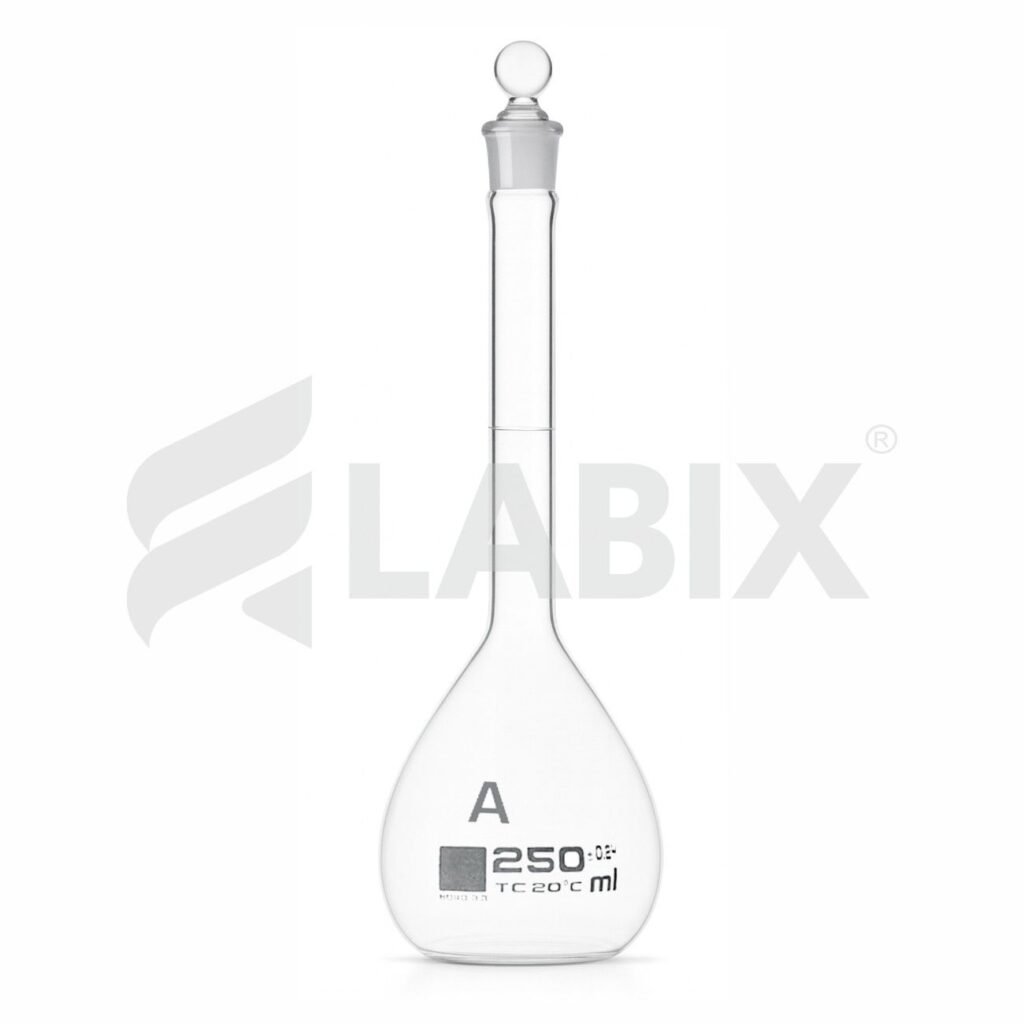
A volumetric flask is a pear-shaped laboratory container with a flat base and a long, narrow neck, designed to hold a precise volume of liquid — typically calibrated at 20°C.
The defining feature is its single calibration mark, which ensures that the flask contains an exact volume when filled to that point.
Key Characteristics:
- Fixed volume (not variable)
- High accuracy (especially Class A)
- Narrow neck for precision control
- Used primarily for solution preparation
Unlike beakers or conical flasks, which allow approximate measurements, a volumetric flask ensures measurement certainty, making it essential for analytical work.
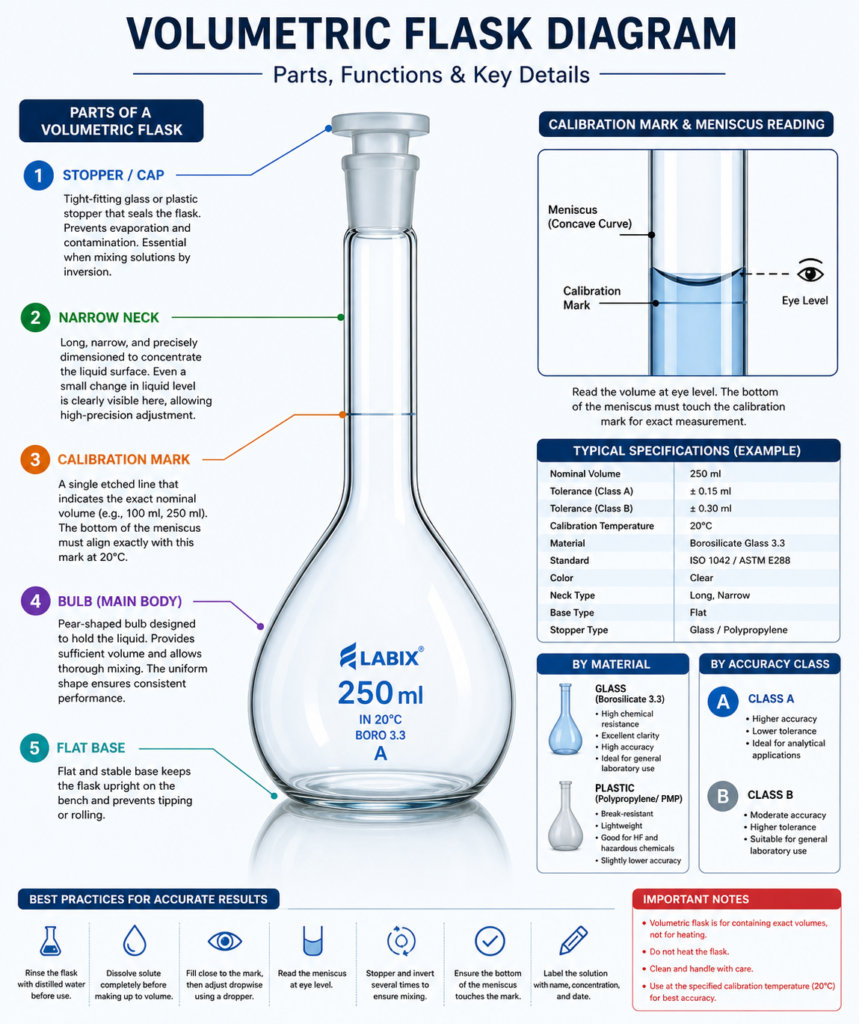
Volumetric Flask Diagram — Parts and Functions
Understanding the volumetric flask diagram helps clarify how each component contributes to accuracy.
Main Parts:
1. Stopper / Cap
Seals the flask to prevent contamination and evaporation. Essential for mixing solutions safely.
2. Narrow Neck
Designed for precise volume adjustment. Even small liquid changes are clearly visible.
3. Calibration Mark
A single etched line indicating exact volume (e.g., 100 ml, 250 ml).
The bottom of the meniscus must align exactly with this mark.
4. Bulb (Main Body)
Holds the solution. The shape ensures uniform mixing and stability.
Volumetric Flask Uses — Practical Applications
The volumetric flask uses are centered around one principle: accurate solution preparation.
1. Preparing Standard Solutions
The most common use. Ensures exact concentration by fixing volume precisely.
2. Dilution of Chemicals
Used to dilute stock solutions using the formula:C1V1=C2V2
Accuracy depends entirely on final volume — which the flask guarantees.
3. Analytical Chemistry
Used in:
- Titrations
- Spectrophotometry
- Chromatography (HPLC)
Without accurate solutions, analytical results become unreliable.
4. Pharmaceutical Applications
Used for:
- Drug formulation
- Calibration standards
- Quality control
Even small volume errors can affect compliance.
5. Research Laboratories
Ensures reproducibility in experiments — critical for valid results.
Types of Volumetric Flasks
By Volume
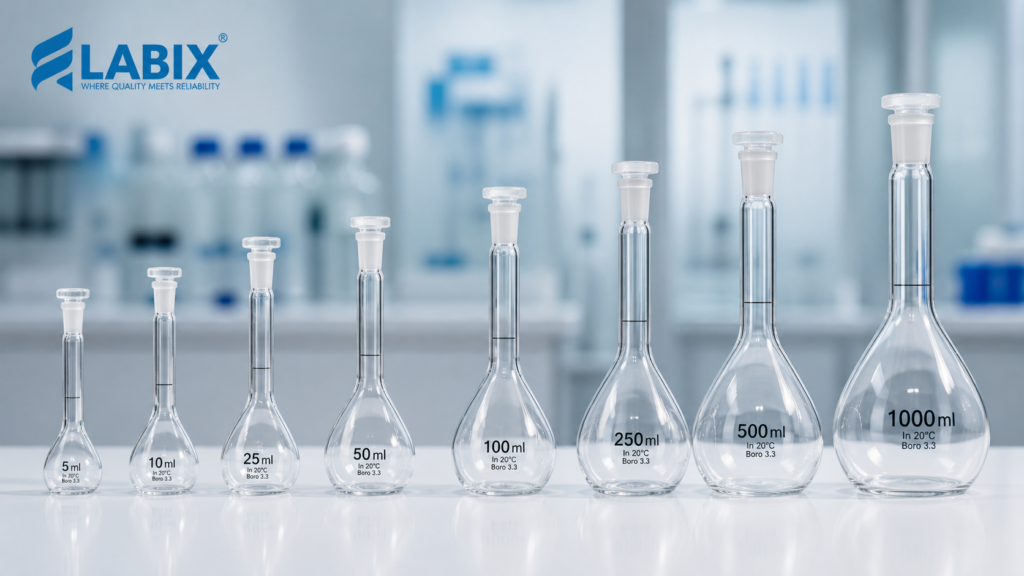
Available in standard sizes:
5 ml → 1000 ml
Most common: 100 ml & 250 ml
By Material
Glass (Borosilicate):
- High chemical resistance
- Better accuracy
- Preferred for analytical work
Plastic:
- Break-resistant
- Used for hazardous chemicals
- Slightly lower precision
Class A vs Class B
| Type | Accuracy | Usage |
|---|---|---|
| Class A | High (±0.12 ml for 250 ml) | Analytical work |
| Class B | Moderate | General lab use |
For serious lab work → always use Class A
How to Use a Volumetric Flask (Correct Method)
- Measure solute accurately
- Transfer into flask completely
- Add ~70% solvent
- Dissolve completely
- Fill near calibration mark
- Use dropper for final adjustment
- Align meniscus at eye level
- Stopper and invert 10–15 times
- Label properly
Most common mistake: wrong meniscus reading
Advantages of Volumetric Flask
✔ Extremely high precision
✔ Standardized measurements
✔ Reliable reproducibility
✔ Chemical resistance
✔ Essential for analytical accuracy
Limitations
⚠ Only one fixed volume
⚠ Fragile (glass)
⚠ Not suitable for heating
⚠ Requires careful handling
⚠ Meniscus reading errors possible
Volumetric Flask vs Other Glassware
| Equipment | Accuracy | Use |
|---|---|---|
| Beaker | Low | Mixing/heating |
| Conical Flask | Medium | Reactions |
| Measuring Cylinder | Moderate | Approx volume |
| Volumetric Flask | Highest | Exact solution prep |
Best choice for precision = Volumetric Flask
Laboratory Best Practices
Cleaning
- Rinse with DI water 2–3 times
- Avoid abrasive brushes
- Air dry inverted
Storage
- Keep upright
- Avoid stacking
- Keep away from sunlight
Handling
- Check for cracks
- Do not heat
- Use correct class (A/B)
- Recalibrate if needed
Wrapping Notes
The volumetric flask represents the perfect balance of simplicity and precision. Its design has remained unchanged for decades because it fulfills one critical need — accurate solution preparation.
From research labs to pharmaceutical industries, the importance of volumetric flask uses cannot be overstated. Mastering its use, understanding the volumetric flask diagram, and applying proper technique directly improves the reliability of laboratory results.