

Types of Glassware Used in Chemistry Laboratories

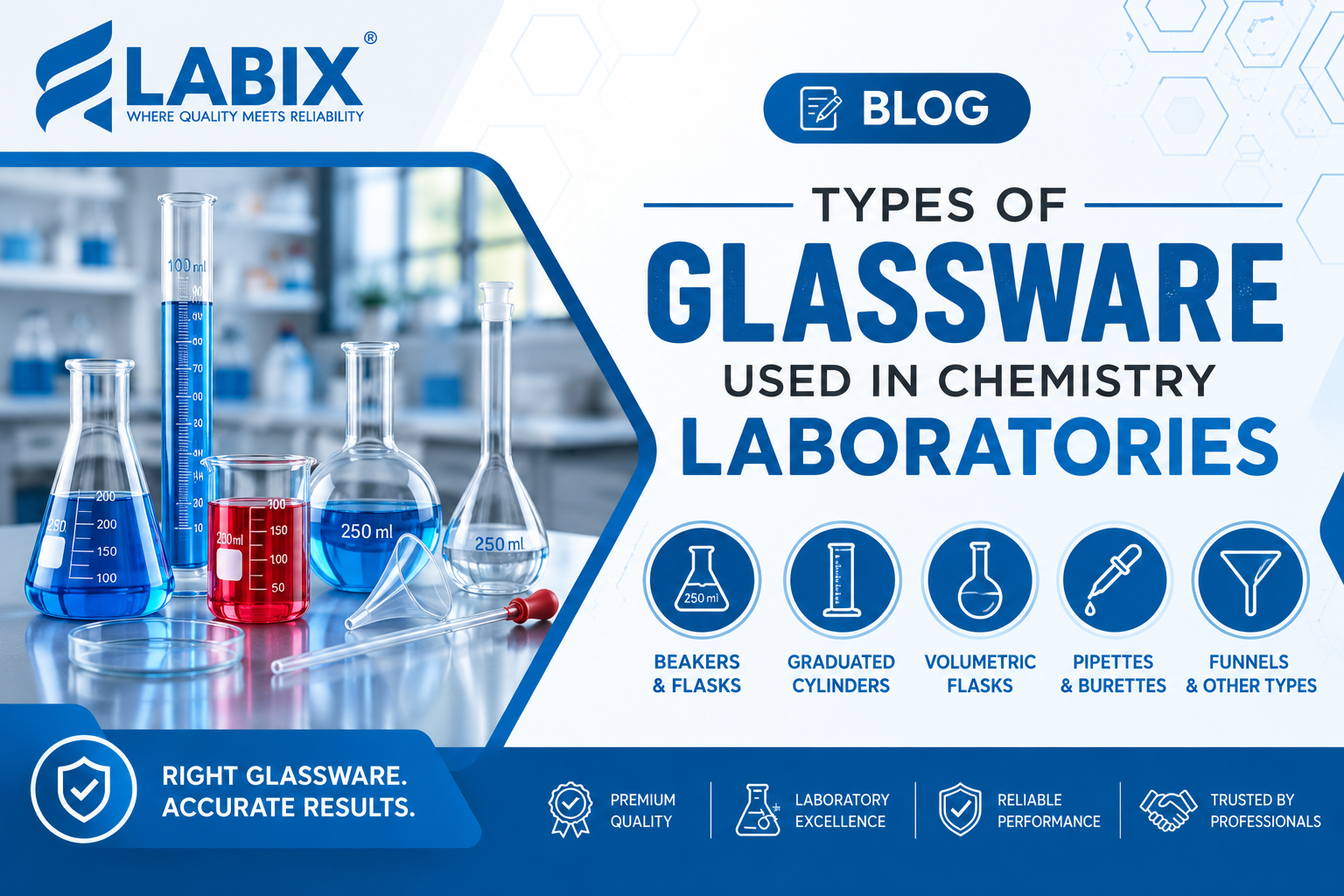
Chemistry laboratories use different types of glassware for measuring liquids, preparing solutions, mixing chemicals, conducting reactions, and transferring samples. Common glassware used in chemistry labs includes beakers, test tubes, Erlenmeyer flasks, volumetric flasks, measuring cylinders, pipettes, burettes, and funnels. Each item has a specific design and purpose, so choosing the correct glassware is important for reliable results and safe laboratory work. Some glassware is designed for general handling, while specialized volumetric instruments are intended for more precise measurements. This guide explains the main types of laboratory glassware, their uses, key differences, and the factors to consider when selecting suitable equipment for educational, research, and professional chemistry laboratories.
What Is Chemistry Laboratory Glassware?
Chemistry laboratory glassware refers to glass equipment used to contain, measure, mix, transfer, heat, or separate substances during laboratory procedures. Its shape, capacity, graduations, and connection design determine how it can be used.
For example, a beaker is useful for mixing liquids, while a volumetric flask is designed to prepare a solution to a specified volume. A pipette transfers a measured quantity of liquid, whereas a burette delivers measured volumes, commonly during titration.
Understanding these differences helps laboratory personnel select appropriate equipment instead of treating all glassware as interchangeable.
Common Materials Used in Laboratory Glassware
Borosilicate glass is widely used for laboratory glassware because of its useful chemical resistance and ability to withstand temperature changes better than many ordinary glass types. It is suitable for many routine laboratory applications, but it is not compatible with every chemical or operating condition.
Glassware material should be selected according to the substance being handled, the working temperature, and the manufacturer’s specifications. The product’s intended use and limitations should always be checked before use.
Common Types of Glassware Used in Chemistry Laboratories
The following glassware items are commonly found in school, college, research, pharmaceutical, and industrial chemistry laboratories. Their functions vary according to their design and the requirements of the experiment.
1. Beakers
Beakers are cylindrical containers with a flat bottom and usually a pouring spout. They are commonly used for holding liquids, mixing solutions, dissolving substances, stirring mixtures, and carrying out suitable laboratory procedures.
Many beakers have graduation markings that provide approximate volume estimates. These markings are useful for routine handling but should not be treated as equivalent to the calibration of precision volumetric instruments.
Beakers may also be used for heating when their material and design are suitable for the procedure. Laboratory personnel should follow the manufacturer’s instructions and avoid sudden temperature changes that could cause breakage.
2. Test Tubes and Boiling Tubes
Test tubes are narrow glass containers used for small-scale experiments, sample handling, mixing, and qualitative chemical tests. Their compact design makes them useful for procedures that require relatively small quantities of material.
Boiling tubes are generally larger than standard test tubes and may be used for suitable procedures involving heating or larger sample quantities.
Not every test tube is designed for heating. Before applying heat, check the tube’s material, design, condition, and intended use. Test tubes should also be supported with appropriate holders when required, particularly during heating or when handling hazardous substances.
3. Erlenmeyer Flasks
Erlenmeyer flasks, also called conical flasks, have a broad base, sloping sides, and a narrow neck. This design allows liquids to be swirled for mixing while helping reduce splashing compared with an open, wide-mouth container.
These flasks are commonly used for preparing and holding solutions, mixing reaction mixtures, and conducting titrations. In a titration setup, the flask often holds the sample solution while the titrant is delivered from a burette.
The narrow neck can also accommodate suitable stoppers or compatible apparatus where the procedure requires them. However, the flask should not be assumed to be pressure-rated or suitable for sealed reactions unless the manufacturer explicitly specifies this.
4. Volumetric Flasks
Volumetric flasks are designed to prepare solutions to a specified volume. They typically have a rounded body, a narrow neck, and a calibration mark indicating the intended filling level.
They are particularly useful when preparing standard solutions, dilutions, and solutions for analytical procedures that require a defined volume.
Unlike a general-purpose beaker, a volumetric flask is intended for a specific calibrated volume. Correct use requires following the calibration instructions, observing the specified filling level, and using appropriate temperature conditions.
A volumetric flask is generally not intended for heating. Users should consult the manufacturer’s instructions and the requirements of the relevant laboratory method.
5. Measuring Cylinders
Measuring cylinders are tall, narrow vessels with volume graduations. They are used to measure liquid volumes for routine laboratory work and solution preparation.
Their shape makes it easier to read liquid levels than in many wide-mouth containers. Measurements should be taken using the correct reading technique, typically at eye level and according to the meniscus-reading instructions applicable to the liquid.
The accuracy of a measuring cylinder depends on its specifications, capacity, graduations, and condition. When a procedure requires greater precision, a suitable volumetric pipette, burette, or volumetric flask may be more appropriate.
LABIX Labware offers measuring cylinders in its laboratory glassware range. Buyers can review the LABIX Measuring Cylinder product page for the listed model and product specifications.
6. Pipettes
Pipettes are used to transfer measured quantities of liquid from one container to another. They are important in analytical chemistry, sample preparation, solution preparation, and procedures requiring controlled liquid transfer.
Different pipette designs serve different purposes. Volumetric pipettes are intended to deliver a specified volume, while graduated pipettes allow users to measure and deliver volumes according to their graduations and specifications.
Correct pipette selection depends on the required volume, measurement accuracy, liquid properties, and laboratory procedure. The correct filling and delivery technique should also be followed.
Pipettes should not be filled by mouth. Use an appropriate pipette aid or device and follow the laboratory’s safety procedures.
7. Burettes
Burettes are graduated glass tubes fitted with a stopcock that allows liquid to be delivered in a controlled manner. They are commonly used in volumetric analysis, especially acid-base and other suitable titrations.
During a titration, a burette delivers a measured volume of titrant into a sample until the required endpoint is reached. The difference between the initial and final readings helps determine the volume delivered.
Reliable results depend on correct filling, removing air bubbles from the delivery tip where applicable, reading the liquid level properly, and checking that the stopcock does not leak.
LABIX provides a Pipettes/Burettes category where laboratories can explore relevant glassware options and review product details.
8. Funnels, Separating Funnels, and Glass Stirring Rods
Funnels help transfer liquids or powders into containers with narrow openings. When used with suitable filter paper or other compatible filter media, they can also support filtration procedures.
Separating funnels are designed for separating suitable immiscible liquid phases, such as two liquids that form distinct layers. They are commonly used in liquid-liquid extraction. Their stopcock allows the lower phase to be drained in a controlled manner.
Glass stirring rods are simple tools used for manually mixing liquids and assisting with liquid transfer. They are different from powered laboratory stirrers, which are used when a procedure requires mechanical mixing.
These items should be selected according to the material being handled and the specific requirements of the procedure.
How Is Different Laboratory Glassware Used?
The correct glassware depends on the task, the quantity of material, and the level of measurement accuracy required.
Measuring and Preparing Solutions
Measuring cylinders are useful for routine volume measurements. Pipettes and burettes are used when measured liquid transfer is required, while volumetric flasks are suitable for preparing solutions to specified volumes.
For example, a laboratory preparing a solution for quantitative analysis may use a volumetric flask for the final volume and a suitable pipette to transfer a measured quantity of stock solution.
Mixing, Heating, and Conducting Reactions
Beakers, test tubes, and Erlenmeyer flasks support different types of mixing and reaction work. A beaker may be convenient for stirring a solution, a test tube may suit a small-scale test, and an Erlenmeyer flask may be preferred when swirling is required.
Heating suitability must be confirmed for the particular item and procedure. Glassware should not be heated, sealed, or subjected to pressure unless its design and documented operating limits permit the intended conditions.
Transferring and Separating Liquids
Funnels are useful for transferring liquids, while pipettes provide measured liquid transfer. Separating funnels are appropriate when a procedure requires separation of immiscible liquid phases.
Choosing the right item helps make the procedure more practical and reduces avoidable handling errors.
How to Choose the Right Chemistry Laboratory Glassware
Laboratories should consider several factors before selecting glassware for routine experiments, teaching, research, or procurement.
Consider the Required Accuracy and Capacity
Start by identifying the volume required and the accuracy specified by the procedure. A beaker’s graduation marks are generally suitable for approximate estimates, while calibrated volumetric instruments are intended for defined measurement tasks.
Select an appropriate capacity and check the product’s calibration details, tolerance, and intended use. Do not assume that every graduated item provides the same measurement accuracy.
Check Material and Chemical Compatibility
Consider the chemicals, solvents, temperature conditions, and other exposures expected during the procedure. Check whether the glass material is suitable for the intended application.
Also consider whether the glassware will be heated, cleaned with specialized agents, or used with a particular apparatus. Consult manufacturer documentation whenever compatibility or operating limits are uncertain.
Review Design and Product Specifications
Before purchasing, check the following:
- Capacity and dimensions
- Graduation and calibration details, where relevant
- Material and intended application
- Joint or connection compatibility, if applicable
- Manufacturer instructions and operating limitations
- Quantity requirements and product identification
For laboratories purchasing multiple items, comparing documented specifications helps ensure that the selected equipment meets the requirements of the intended procedures.
Safe Handling, Cleaning, and Storage of Laboratory Glassware
Appropriate care helps reduce contamination, breakage, and avoidable equipment damage.
Clean Glassware After Use
Use a suitable cleaning method based on the substances handled and the next application. Rinse thoroughly according to the laboratory procedure and avoid cleaning agents that may damage the glassware or leave interfering residues.
Glassware containing hazardous substances may require specialized decontamination and disposal procedures. Follow laboratory SOPs and relevant safety documentation.
Inspect Glassware Before Use
Check for cracks, chips, damaged rims, and defective joints. Damaged glassware should be removed from service and handled according to the laboratory’s broken-glass procedure.
Do not force mismatched joints together or continue using visibly damaged equipment.
Store Glassware Correctly
Store clean glassware in a suitable, dry location using appropriate racks, shelves, or compartments. Avoid unstable stacking and protect delicate items from impacts.
Keep clean glassware separate from used or contaminated equipment. Special-purpose glassware may also need dedicated storage to reduce cross-contamination.
Frequently Asked Questions
What are the most commonly used types of glassware in chemistry laboratories?
Common examples include beakers, test tubes, Erlenmeyer flasks, volumetric flasks, measuring cylinders, pipettes, burettes, and funnels. Each is designed for different laboratory tasks.
Which laboratory glassware is used for accurate volume measurement?
Volumetric flasks, suitable volumetric pipettes, and burettes are commonly used for specified volumetric tasks. Measuring cylinders are useful for many routine measurements. The right choice depends on the required accuracy and product specifications.
What is the difference between a beaker and an Erlenmeyer flask?
A beaker has a relatively wide opening and is useful for holding, mixing, and transferring liquids. An Erlenmeyer flask has sloping sides and a narrow neck that support swirling and help reduce splashing during mixing.
Why is borosilicate glass commonly used in laboratories?
Borosilicate glass offers useful chemical resistance and thermal properties for many laboratory applications. However, suitability depends on the specific chemical, temperature, and product design.
Can all laboratory glassware be used for heating chemicals?
No. Heating suitability depends on the glassware’s material, design, condition, and documented operating limits. Always check manufacturer instructions and follow the relevant laboratory procedure.
Conclusion
Understanding the types of glassware used in chemistry laboratories helps students, researchers, and laboratory managers choose suitable equipment for measuring, mixing, transferring, heating, and separating substances. Beakers, flasks, test tubes, measuring cylinders, pipettes, and burettes each serve different purposes, and they should not be treated as interchangeable. Selection should consider measurement accuracy, capacity, material compatibility, and intended application. Proper cleaning, inspection, and storage are also important for reliable laboratory work. Laboratories can explore the LABIX Labware laboratory glassware range to review relevant products and compare their specifications with their laboratory requirements.