
What Is a Volumetric Flask? Uses, Types, and Class A vs. B

Introduction
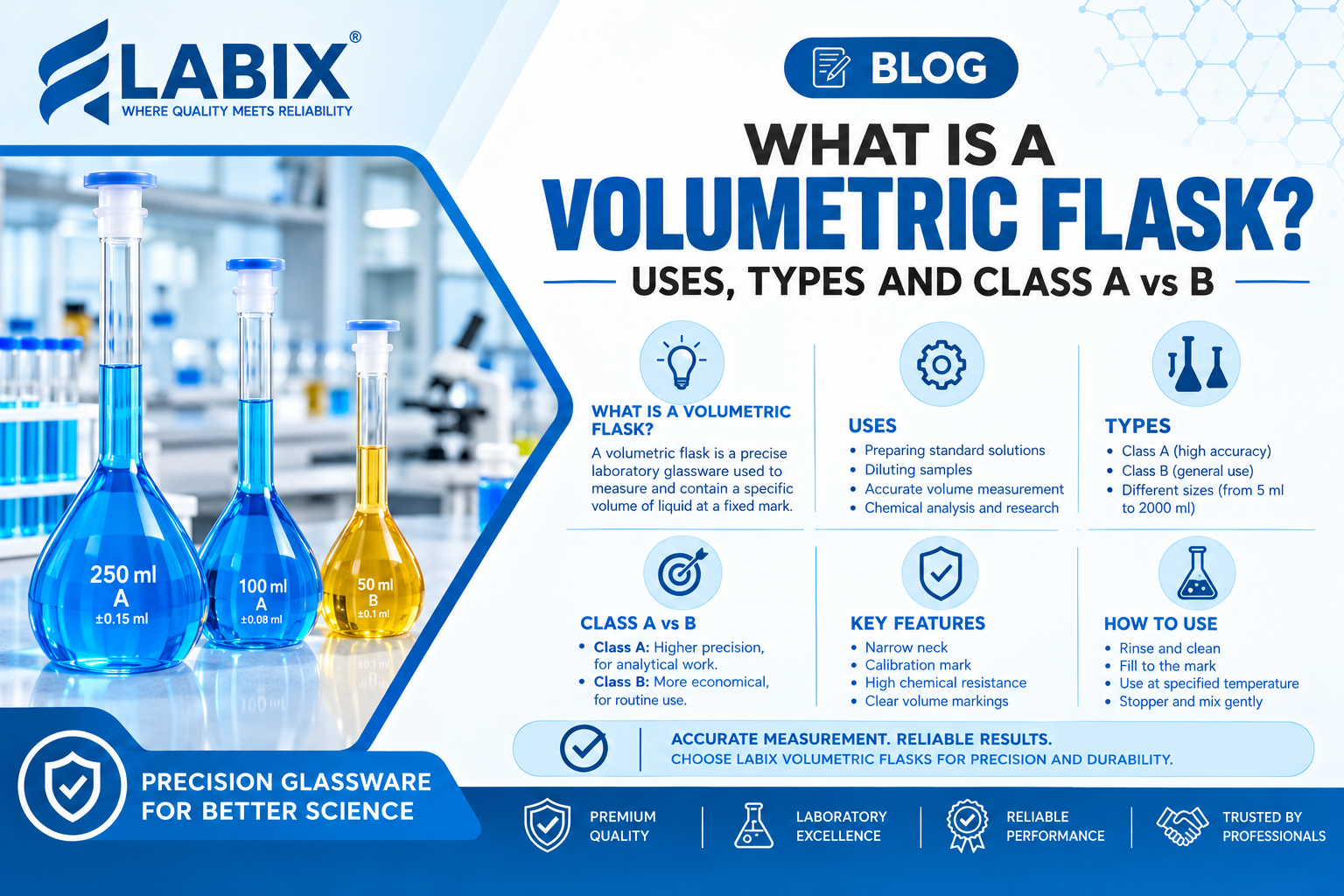
A volumetric flask is laboratory glassware designed to contain a specific volume of liquid at a stated reference temperature. Laboratories use it to prepare standard solutions, dilute stock solutions, and prepare reagents for chemical analysis. Its rounded body, narrow neck, calibration mark, and stopper help users bring a solution to a defined final volume.
Understanding volumetric flask uses helps students, researchers, and laboratory professionals select suitable glassware for their work. Different capacities and accuracy classes meet different laboratory requirements. Class A and Class B volumetric flasks generally differ in their permitted volume tolerances. This guide explains their uses, types, accuracy classes, correct handling, and selection considerations.
What Is a Volumetric Flask?
A volumetric flask is calibrated laboratory glassware designed to contain a specified volume of liquid under defined conditions. It is particularly useful when a laboratory procedure requires a solution with a known final volume.
The flask typically has a rounded body, a narrow neck, a calibration line, and a stopper. The calibration line indicates the liquid level required to achieve the specified volume at the stated reference temperature.
Unlike a beaker, which is mainly used for holding and mixing liquids, a volumetric flask supports controlled solution preparation. Laboratories use it in analytical chemistry, pharmaceutical testing, scientific research, and education.
A volumetric flask does not independently measure the mass of a solute or guarantee a particular concentration. Accurate preparation also depends on the quantity and purity of the ingredients, complete dissolution, temperature, and correct laboratory technique.
Key Parts of a Volumetric Flask
- Body: Holds the solution.
- Narrow neck: Allows careful adjustment of the liquid level.
- Calibration mark: Indicates the specified filling level.
- Stopper: Helps prevent spills and contamination during mixing.
- Base: Supports the flask on a laboratory surface.
What Are the Main Volumetric Flask Uses?
Volumetric flask uses mainly involve preparing solutions to a defined final volume.
1. Preparing Standard Solutions
Laboratories use volumetric flasks to prepare standard solutions for analytical procedures. A technician measures the required quantity of solute, dissolves it in a suitable solvent, and adjusts the solution to the calibration mark.
The final concentration depends on the amount of substance, its relevant chemical properties, and the final solution volume.
2. Diluting Stock Solutions
A volumetric flask helps prepare diluted solutions from concentrated stock solutions. The user transfers the calculated amount of stock solution and adds a suitable solvent until the liquid reaches the calibration mark.
This process supports routine laboratory testing, chemical analysis, and research.
3. Preparing Laboratory Reagents
Researchers and technicians use volumetric flasks to prepare reagents for chemical reactions, experiments, and analytical procedures. Following a consistent preparation method helps improve reproducibility.
4. Pharmaceutical and Quality-Control Testing
Pharmaceutical and industrial laboratories may use volumetric flasks when preparing solutions for validated analytical methods, sample testing, and quality-control procedures. The required accuracy class depends on the applicable method.
5. Education and Scientific Research
Students use volumetric flasks to learn solution preparation, dilution calculations, and quantitative laboratory techniques. Researchers use them when experiments require solutions with defined final volumes.
Explore the product: For laboratory solution preparation, view the LABIX Amber Color Volumetric Flask and check its listed capacities and specifications before selecting a suitable flask.
Example of Preparing a Standard Solution
Suppose a laboratory procedure requires 100 mL of a solution. The user transfers the calculated quantity of solute into a suitable 100 mL volumetric flask and adds an appropriate solvent.
After the solute dissolves completely, the user adds more solvent until the appropriate meniscus aligns with the calibration mark at eye level. The user then closes the flask and mixes the contents thoroughly by gentle inversion.
The exact procedure should follow the laboratory method, particularly when temperature, dissolution, or chemical reactions may affect the final volume.
Types of Volumetric Flasks
Volumetric flasks can be classified by capacity, material, and accuracy class. The appropriate choice depends on the application and the manufacturer’s specifications.
Volumetric Flask by Capacity
Common laboratory capacities include 25 mL, 50 mL, 100 mL, 250 mL, 500 mL, and 1,000 mL, although other sizes are available.
- 25–50 mL: May suit small-volume solution preparation.
- 100–250 mL: May suit routine analytical procedures.
- 500–1,000 mL: May suit larger-volume solution preparation.
The required final volume and laboratory method should determine the capacity.
Clear and Amber Volumetric Flasks
Clear glass allows users to observe the solution and read the meniscus. Amber glass may be appropriate for light-sensitive substances that require protection from light.
The choice should account for chemical compatibility and the requirements of the procedure. Amber color alone does not establish the accuracy class of a flask.
Class A and Class B Flasks
Volumetric glassware is classified into Class A and Class B based on its measurement accuracy, not its shape. Class A flasks offer greater precision due to their tighter allowable volume tolerances compared with similar Class B flasks. On the other hand, Class B glassware allows slightly wider tolerances and is commonly used for routine laboratory applications.
Class A vs. Class B Volumetric Flask
Selecting between Class A and Class B depends on the volume tolerance required by the laboratory procedure.
Class A Volumetric Flask
Class A volumetric flasks generally meet tighter volume-tolerance requirements than comparable Class B flasks. Laboratories may select them for standard-solution preparation, quantitative analysis, and quality-control procedures that require tighter volume control.
Before purchasing, check the flask’s stated capacity, tolerance, calibration temperature, and any required calibration documentation.
Class B Volumetric Flask
Class B volumetric flasks generally have wider permitted tolerances than comparable Class A flasks. They may suit routine laboratory work and educational activities when their stated tolerances meet the procedure’s requirements.
Class B glassware is not automatically unsuitable for analytical work. The appropriate choice depends on the method, required accuracy, and applicable standards.
Class A vs. Class B Comparison
| Feature | Class A | Class B |
| Permitted volume tolerance | Generally tighter | Generally wider |
| Typical selection | Procedures requiring tighter volume control | Procedures accepting wider tolerances |
| Documentation | Check required calibration records. | Check stated specifications. |
| Suitability | Depends on method requirements | Depends on method requirements |
Exact tolerances vary by nominal capacity and applicable standard. Always consult manufacturer documentation rather than assuming that all flasks within a class have identical tolerances.
How to Use a Volumetric Flask Correctly
Correct technique helps laboratories prepare solutions consistently.
- Select the flask: Choose the required capacity and accuracy class.
- Inspect the glassware: Check for cracks, chips, and contamination.
- Transfer the ingredients: Add the measured solute or stock solution using suitable equipment.
- Dissolve the solute: Add an appropriate solvent and mix until dissolution is complete.
- Control temperature: Allow the solution to reach the required calibration temperature when necessary.
- Adjust the final volume: Add solvent gradually until the appropriate meniscus aligns with the calibration mark.
- Mix thoroughly: Stopper the flask and invert it repeatedly.
Common Mistakes to Avoid
Avoid filling beyond the calibration mark, reading the meniscus from above or below eye level, or adjusting the final volume before the solute has dissolved. Temperature changes can affect volume measurements. Do not use a volumetric flask for direct heating unless the manufacturer explicitly permits the intended use.
How to Choose the Right Volumetric Flask
Consider the following factors when selecting laboratory glassware:
- Capacity: Match the flask to the final volume required.
- Accuracy class: Select Class A or Class B according to the method’s tolerance requirements.
- Material compatibility: Confirm that the flask suits the solution and operating conditions.
- Light protection: Consider amber glass for light-sensitive substances.
- Calibration details: Check the stated tolerance, reference temperature, and applicable standard.
- Documentation: Obtain calibration records or certificates when the laboratory procedure requires them.
For example, a laboratory preparing standard solutions for quantitative analysis may require tighter volume tolerances than a routine teaching experiment. The laboratory method should determine the appropriate flask.
Volumetric Flask vs. Measuring Cylinder and Beaker
Different laboratory vessels serve different purposes.
| Feature | Volumetric Flask | Measuring Cylinder | Beaker |
| Main purpose | Preparing a specified final volume | Measuring different liquid volumes | Holding and mixing liquids |
| Design | Narrow neck with calibration mark | Graduated scale | Wide opening and spout |
| Typical measurement use | Controlled solution preparation | Routine volume measurement | Approximate volume estimates |
| Selection | When a specified final volume is required | When different volumes must be measured | When general handling and mixing are required |
A volumetric flask is suitable when a method requires a defined final volume. A measuring cylinder provides measurements across a range, while a beaker is useful for general laboratory handling. Actual measurement performance depends on the instrument’s specifications.
Cleaning, Handling and Storage
Proper cleaning and handling help protect volumetric glassware from contamination and damage.
- Clean the flask using a method compatible with the residue and glass material.
- Rinse it according to the laboratory procedure.
- Inspect the flask and stopper for cracks, chips, and damage.
- Avoid sudden temperature changes.
- Do not use the flask as a heating vessel unless the manufacturer permits the intended conditions.
- Store it securely in a clean location.
- Follow laboratory SOPs and manufacturer instructions for calibration and handling.
Frequently Asked Questions
What is the main purpose of a volumetric flask?
A volumetric flask prepares a solution to a specified final volume. Laboratories commonly use it to prepare standard solutions and dilute stock solutions.
Why does a volumetric flask have a narrow neck?
The narrow neck allows users to adjust the liquid level carefully and align the meniscus with the calibration mark.
Can a volumetric flask be heated?
A volumetric flask is generally not intended for direct heating. Follow the manufacturer’s instructions and the laboratory procedure.
How do you read the calibration mark?
For most transparent aqueous solutions, view the meniscus at eye level and align its bottom with the calibration mark.
Is a volumetric flask more accurate than a measuring cylinder?
A volumetric flask is calibrated for a specified volume, while a measuring cylinder provides graduated measurements across a range. Actual tolerances depend on the instrument specifications.
How do you choose between Class A and Class B?
Choose according to the required volume tolerance. Class A generally has tighter permitted tolerances, while Class B may suit procedures that accept wider tolerances.
Conclusion
A volumetric flask is essential laboratory glassware for preparing solutions to a specified final volume. Its design supports standard-solution preparation, stock-solution dilution, research, and quality-control testing. Understanding the differences between Class A and Class B helps laboratory professionals choose glassware that meets their measurement requirements.
Capacity, material compatibility, calibration specifications, and correct handling all contribute to reliable results. Explore the LABIX Amber Colour Volumetric Flask to review the product details and determine whether it suits your laboratory’s needs.